Sunday, 26 June 2011

How far goes the euro - Cuanto dura un euro

Sunday Market in Chang Mai
Almost nothing is needed for going to Asia: you need to book a flight, to be open-minded and to have a trained ability to adapt. It is literally a marvel to realize how much can be done with few cents. The famous penny saved in the pig shaped moneybox for a rainy day would here buy things one can just dream of back home. What can I do with three euros back home? I can get bread and milk, or a return metro ticket while here I can have lunch, dinner and get drinks. A honest tuk tuk takes me around for only a few cents, a big bottle of water costs twenty cents, one hour of Thai massage 3,50eu. Last week I went to the Sunday market and forgot to take money with me. I had only twenty euros. After two shirts, two skirts, one short, dinner, fruitshake, one hour massage, souvenirs and a taxi ride, those twenty euros were still not over! And if you, understandably, do not believe me, come and see with your own eyes!
*** *** ***
Sipping dragon-fruit shake,
buying everything,
spending nothing!
Face: 'This can't be true'
Per andare in Asia non serve quasi niente: occorre pagarsi un biglietto aereo, avere una mente aperta e un'allenata capacità d'adattamento. E' una meraviglia accorgersi di quanto si possa fare con qualche spicciolo. I famosi centesimi buttati in un salvadanaio per un giorno di pioggia, qui comprano cose che a casa ci si sogna. Con tre euro a casa posso comprare latte e pane o un biglietto a/r della metro. Qui con tre euro bevo, pranzo e ceno. Un tuk tuk onesto ti porta in giro per pochi centesimi, una bottiglia d'acqua costa circa venti centesimi, un'ora di massaggio tailandese 3,50 eu. La settimana scorsa sono andata al mercato della domenica dimenticandomi di portarmi dei soldi. Avevo solo venti euro.
Due magliette, due gonne, un pantaloncino, una cena, uno shake di frutta, un'ora di massaggio, souvenir vari e una corsa in taxi non sono bastati a finire quei venti euro! Se la cosa non vi persuade, venite e provate per credere, ahah ;)

Saturday, 25 June 2011

Curiosità/y

Chang beer in cooling case
This is curious indeed. Did you know that whenever election time is approaching in Thailand, the country is under an alcohol ban? You read it right, no drinking before voting. General elections will be held in the country on 3 July and Thai people must return to their registered birthplace in order to vote. It doesn't make any sense. Still, to allow Thai people to reach their place and perform their citizen's duties in the best of their capacities, free days are given. Not just free days, but special alcohol-free days as well! Thai people drink. Not as much as Czeck or Irish, but after a day working in the fields, they may drink to relax and forget for one moment how hard is their life. Alcohol-free days are also common for a number of Buddhist holidays and Royal days, but still, I wonder how drinking can really affects one's ability to cast a vote...Now, imagine the tourist that arrives in Thailand in these special days before elections, ready to enjoy a typical holiday on the beaches of Pukhet and Pattaya and then finds out he can't even get himself a beer. Well, that's hilarious! 

*** *** ***
Questo é veramente curioso. Lo sapevate che quando in Tailandia si avvicina il momento delle elezioni, l'alcol é bandito nell'intera nazione? Avete letto bene, non si beve prima di votare. Nel Paese ci saranno elezioni generali il 3 luglio e per votare i tailandesi devono tornare nel loro luogo di nascita, quello registrato come tale. Ovviamente non ha alcun senso. Fatto sta che per consentire ai tailandesi di raggiungere la loro meta e adempiere ai  loro doveri di cittadini nel pieno delle loro facolta', sono previsti dei giorni liberi, ma non semplicemente liberi, giorni speciali liberi dall'alcol! In Tailandia la gente beve. Non come in Irlanda o Repubblica Ceca, ma dopo un giorno passato a lavorare nei campi magari bevono per rilassarsi e dimenticarsi per un attimo quanto é dura la vita. Giorni senza alcol sono prassi comune anche in occasione di certe festività buddiste e reali, ma mi chiedo quanto l'alcol possa davvero influenzare la capacità di sbarrare una casella o mettere una x su un volto...Ora, immaginatevi il turista che arriva in Tailandia in questi giorni speciali pre-elezioni, pronto a godersi la tipica vacanza sulle spiagge di Pukhet e Pattaya per poi scoprire che non puo' neanche comprarsi una birra. Questo, signori miei, é esilarante!

Wednesday, 22 June 2011

Waiter - Cameriere

Zaw Lay is 25 and until a year ago his life was in the capital of Burma, Rangoon. Then, he decided to get on a bus directed to Thailand with only a bunch of money. He is not the first nor will be the last, many others have done it. When one lives in fear and insecurity, surrounded by censorship and control, escaping is one of the options likely to be considered. He has no documents, no passport, no ID card. He bribed the officer at the check point and managed to enter the neighbouring country. He is a shadow. He cannot raise his voice and is of course underpaid. He works as a waiter at a local restaurant and has no time for himself. Recently, he won his shyness and understood that can learn a few things of English when I go have dinner at that restaurant. He has a pen, a copybook, a dictionary and willingness. He waits for me to finish dinner and chitchatting, and then comes offering me fruits and sitting next to me. He's all ears. It's good I can help him, but it all leaves me with a rather bitter taste.

*** *** ***
Zolei ha 25 anni e fino a un anno fa la sua vita era nella capitale birmana Rangoon. Un giorno decide di salire su un bus diretto in Tailandia con solo una manciata di soldi. Non é né il primo né l'ultimo, lo hanno fatto in tanti altri. Quando si vive nella paura e nell'insicurezza, circondati da censura e controlli, fuggire é una delle opzioni inevitabilmente prese in considerazione. Non ha uno straccio di documento, né una carta d'identità, né il passaporto. Ha pagato l'ufficiale alla frontiera sottobanco e da allora sta qui nello Stato confinante. E' un'ombra. Non puó alzare la voce ed é sottopagato. Lavora come cameriere in un ristorante locale e non ha tempo per sé stesso. Di rencente ha vinto la sua timidezza e ha capito che puó imparare qualcosa d'inglese quelle volte che vado a cenare al ristorante. Si munisce di penna, quaderno, dizionario e buona volontà. Cuando finisco la mia cena e la mia chiacchiera, viene a offrirmi della frutta e si siede lí con me tutto orecchie. Nonostante mi ritrovi in ruoli in cui mai avrei pensato di ritrovarmi, son contenta di dargli una mano, ma la cosa mi lascia con un sapore alquanto amaro.

Tuesday, 21 June 2011

F a l a n (s)

It's incredible how much you can learn from these little ones if you listen carefully. Today we were playing on the world's map and travelling across cultures and customs, having to place each person in its place. They love maps and they know geography well. They know that teacher, pizza and Lamborghini come from Italy and they know where Rome is. They know that Brazil has great football and which countries are Thailand's neighbours. They pronounce Afghanistan without the S as many other words where the S comes in the middle. And then there is France and how I have been inspired. I might have finally understood where the word farang originated from. Pronounced faLang, farang is the Thai word for us white-skin Westerns, somehow like gringo in South America. My 8-11 years old students pronounce France 'falaŋ'. Why? The r is very often pronounced as an L, vowels are always added in between consonants (so the A between f and r) and the S tends to disappear as I've already said. And there you have it, falang! A quick google search confirms that 'It is commonly assumed that the word “Farang” derives from the 17th century when Thailand first made lasting contact with France'. From France came the white foreign people to this land and now farang is the word they use when they refer to the many me and to many white things. A potato is called maan farang!
*** *** *** 
E' incredibile quanto s'impari da questi piccoli ascoltandoli attentamente. Oggi giocavamo sulla mappa del mondo viaggiando tra usanze e culture e mettendo ogni persona al suo posto. Questi piccoli adorano le mappe e ne capiscono di geografia. Sanno che la maestra, la pizza e le Lamborghini vengono dall'Italia e sanno dov'é Roma. Sanno che il Brasile ha un calcio eccezionale e sanno quali sono gli Stati vicini della Tailandia. Pronunciano Afghanistan senza S, cosí come tante altre parole dove la S cade in mezzo. E poi c'é la Francia e la mia illuminazione. Credo di aver finalmente acchiappato da dove viene la parola farang. Pronunciato faLang, farang é la parola con cui qui si riferiscono a noi stranieri dalla pelle bianca, un pó come i gringo in Sudamerica. I miei studenti tra 8-11 anni pronunciano France 'falaŋ'. Come mai? La r é molto spesso pronunciata come una L, vocali sono sempre aggiunte tra consonanti come in questo caso la A tra la f e la r, e la S tende a sparire come ho detto prima. Ed ecco qua il risultato: falang! Una veloce ricerchina su Google mi suggerisce che il mio ragionamento ha senso: "generalmente si assume che la parola 'Farang" derivi dal XVII secolo, quando la Tailandia cominciò a stabilire contatti duraturi con la Francia'. Dalla Francia é venuta in queste terre gente straniera dalla pelle bianca e oggi farang é la parola con cui si riferiscono a quei tanti come me e a quelle tante cose bianche. Una patata é una maan farang

Saturday, 18 June 2011

The present future - Il futuro presente

It hit me the other day: here we are already in the year 2554. What shall we do then with all the blablabla of Nostradamus and the end of the world next year? Gotta love the Buddhist calendar! :)

*** *** ***
L'altro giorno ho avuto 'sto flash: ma se qui siamo già nel 2554, che ce ne facciamo di tutte le chiacchiere di Nostradamus e della fantomatica fine del mondo l'anno prossimo? Mo' usiamo tutti il calendario lunisolare buddista! :)

Friday, 17 June 2011

the Alien - ha le antenne ed é verde!

Rambutan
Ah, tropical fruit, so many shapes, and colours! What a flavour! The fruit in the picture is the so called rambutan! It tastes like a lychee, sweet and juicy, but less liquid and far more scenic with its hairy funny surface and alien look! Fruit is quite something here. Some fruits may look like toys, like the so called dragon fruit. Mangoes are delicious and those not yet ready are eaten with a bit of sugar and chili. It's the typical Thai sweet-spicy flavour. Banana's are wonderful, with lots of varieties and measures. My friend PiiSea told me there are about 205 different types in Thailand, but google didn't confirm such number, so I guess she meant 25. Still, I only knew three types of banana: average chiquitas, big platanos and those little ones I saw in Brazil. What matters is to be careful with pronouncing kluay (banana) with the right tone, otherwise they think you are talking about a man's package :) Ah, those tonal languages! But this will be the subject of another post!
*** *** ***

Banana's at Somphet Market in Chang Mai
Ahh, la frutta tropicale! Quante forme, quanti colori, che aromi, che sapori! Quello nella foto sopra é il cosidetto rambutan! Ha il sapore di un litchi, dolce e succoso, ma meno liquido e molto più scenico con la sua superficie plastico-pelosa e il suo aspetto marziano! Qua la frutta é tutto un programma. Alcuni tipi sembrano giocattoli, come il cosidetto frutto del drago. I mango sono deliziosi, quelli non ancora maturi se li mangiano anche in un pò di zucchero e chili. Il tipico dolce-piccante tailandese. Le banane sono il pezzo migliore per le tante varietà che si incontrano. Ce n'é di tutte le misure e colori. La mia amica Piisii mi ha detto che in Tailandia ci sono qualche 205 varietà di banane, ma dato che google non ha confermato l'informazione mi sa che intendeva 25. E comunque, fino ad ora io conoscevo solo tre tipi: la solita chiquita, il lungo platano e quelle piccole viste in Brasile. L'importante é non pronunciare kluey (banana) con un tono diverso sennò ci si riferisce a tutt'altra cosa, cioé al famoso 'unico frutto dell'amor' :) Ah, le lingue tonali! Ma questo sarà l'argomento di un altro post!

Wednesday, 15 June 2011

Death under my feet - La morte sotto ai piedi

Jackie gecko is everywhere. I always meet it in the kitchen, but also in my bathroom when it doesn't opt for just staring at me from the window. Nobody seems to notice it but me as I am not used to see it welcomed inside. Nonetheless, this nice little animal of the weirdest sound cleans up everything, as many other little contributors to the natural food chain do. 
The wooden floor at the school cannot be lifted and anything could go in between those crack holes. Two days ago the stink of death was coming out of the hole in the picture. It may have been a rat or any other animal capable of remaining stuck in there. It wasn't nice. In the uncertainty of what to do, nothing was done and the bad smell went away by itself. Who must have dined with it??

*** *** ***

Jackie gecko é dappertutto, di solito lo sorprendo sempre in cucina, ma mi entra anche in bagno o rimane a guardarmi dalla finestra. Nessuno ci fa caso tranne me dato che non sono abituata a vederli benvenuti in casa. Eppure questo grazioso animaletto dal verso stranissimo ripulisce la qualsiasi, così come gli altri a me non troppo noti contributori della catena alimentare. 
Il pavimento di legno a scuola non si può smontare e tra quelle fessure può passare di tutto. Due giorni fa un tanfo di morte saliva da quella fessura nella foto. Sarà stato un ratto, o un qualsiasi altro animale capace di restarci bloccato. Non era piacevole. Cosa si fa, cosa non si fa e il cattivo odore se n'é andato da solo. Chi se lo sarà pappato??

Monday, 13 June 2011

♥ the King and Buddha

This beautiful white temple in the picture is the famous Wat Rong Khun in Chang Rai. Its architect Mr. Chalermchai Kositpipat says to have been inspired by two things Thai people are all in love with: the King and Buddha. Kositpipat designed a temple complex of nine temples, as the King Rama IX, respected, loved and worshiped by his people. The white temple is the only one of them to be finished. 
This unconventional temple is not made of gold. White is the symbol of Buddha's purity and the glass of its  enlightening wisdom. It is impressive. The Thai monarchy has been protagonist of these people's life for around 700 years and Buddhism for 800. These institutions have been around from before Thai people could ever remember. "The king is good man, the king has always been and will be there!", at the King's anniversary Thai people are in tears! :) check this video!
*** *** ***


Questo magnifico tempio in foto é il famoso Wat Rong Khun di Chang Rai.
L'architetto, Chalermchai Kositpipat, dice di essere stato inspirato da due cose che tutti i tailandesi amano: il Re e Budda. Kositpipat ha designato un complesso di nove templi, come Re Rama IX, rispettato, amato e idolatrato dalla sua gente. Il tempio bianco é l'unico dei nove ad essere ultimato. 
Questo tempio non convenzionale non é fatto d'oro. Il bianco simboleggia la purezza del Budda e il vetro la sua illuminante saggezza. E' incredibile. La monarchia tailandese é protagonista della vita di questa gente da circa 700 anni e il buddismo da circa 800. Queste istituzioni fanno parte del loro vissuto da tempo immemore..."il Re é una buona persona, é sempre stato lí e sempre ci sará!" e per l'anniversario del Re sono tutti in lacrime! come si vede in questo video!

Sunday, 12 June 2011

One hour in Laos

Today I've been one hour in Laos! It's not as cool as it sounds.  I have just crossed a border and what I have seen was barely another country. Though many faces were new, some scenes were authentic, like this fisherwoman, away from the border markets full of foreigners, just patiently fishing with her net. I spent half an hour sitting and taking pictures of the scene. And click after click I got lost in my thoughts...'I must get back here to these lands, with their endless rice fields, lush vegetation, refreshing rain, kind people, panoramas I'm not used to, there's so much to see, to hear, to learn, I can't wait to be retired! We'll make a big tour going all through Malaysia, Thailand, Laos, Cambodia and Vietnam, we'll get til Menghai in China, I want to see it all, I wish by then also Burma will be travelable, I'll have my best travel partner by my side, it will be unforgettable...' and at that point the guide called back, 'farang let's go back to Thailand'!

Oggi ho trascorso un'ora in Laos! Non é così figo come sembra. Ho attraversato una frontiera e quello che ho visto era a stento un altro paese. Però molti volti erano nuovi, qualche scena autentica, come questa pescatrice, lontana dai mercati di frontiera pieni di forestieri, che pescava pazientemente con la sua rete in acqua. Sono stata mezz'ora seduta a scattare foto della scena e click dopo click mi sono persa nei miei pensieri...'tornerò in queste terre, con le loro infinite risaie, vegetazione lussureggiante, pioggia rinfrescante, persone gentili, panorami a cui non sono abituata, c'é così tanto da vedere, sentire, imparare, non posso aspettare di essere in pensione! Faremo tutto un gran giro per la Malesia, la Tailandia, il Laos, la Cambogia e il Vietnam, arriveremo fino a Menghai in Cina, voglio vedere tutto, magari allora anche la Birmania sarà viaggiabile, avrò il mio migliore compagno di viaggio a fianco, sarà indimenticabile...' e a quel punto la guida mi richiama all'appello, 'farang si ritorna in Tailandia'!

Saturday, 11 June 2011

Colazione Modest(a) Breakfast

Today's breakfast
I got one thing about breakfast here. They all eat what they want! Choice is made among a lot of things I wouldn't even think of eating for breakfast, such as: fish, rice soup, spicy soup, rice, pork or chicken, deep-fried stuff. But a sound traveler knows that 'when in Rome, do as the Romans do', every country has its customs and, in few words, one has to adapt. So I've been trying a couple of things. My favourite are banana fritters! With a bunch of sweet deep-fried banana's in the morning I won't be hungry until 2pm. Today I started the day with mini-ananas, banana fritters and deep-fried sweet mais balls. You won't believe how delicious all that is!
*** *** ***

The lady preparing banana fritters!
Sulla colazione qui ho capito una cosa: ognuno si mangia quello che vuole! La scelta però é tra cose che normalmente neanche mi sognerei di mangiare a colazione, come pesce, zuppa di riso, riso piccante, riso, maiale o pollo, roba fritta. Ma un viaggiatore come si deve lo sa che 'quando a Roma vai, fa come vedrai', paese che vai usanze che trovi e cosí via, insomma bisogna un pó adattarsi. Cosí ho cominciato a provare qua e là. Le mie preferite sono le banane fritte! Con una bella manciata di banane dolci fritte in pastella e olio di non so chè, la fame non si fa sentire prima delle 2. Oggi ho cominciato la giornata con mini ananas (dolcissimi!), banane fritte e palline di mais dolce fritte. Non potete immaginarvi quanto sia delizioso tutto questo!

Friday, 10 June 2011

Asian girl - Ragazza asiatica

Napdaw offering flowers
at Wat Hua Khwang
Napdaw is all stunning and ready for going to the temple. For the occasion of the last day of the flower festival, she started to take care of her make up hours before. She decided to wear the typical Thai wrap skirt and a blouse oriental style. She arranges her hair with baby powder and adds detail over detail: a belt, hairclips, earrings. She is beautiful. She invited me to join her and I am wearing just a simple dress. I feel so underdressed. Later, also her friends join us. Their faces are so delicate. We look at each other. We are attracted by each other's distinctive features. She's so beautiful, I think. "You are so beautiful" she tells me. I'm surprised, I think she's just being nice to me, but I can't help asking "why?". She takes her hand on her nose and shyly says "I almost have no nose!". Hahaha, who would have said that my Mediterranean nose'd be so enticing here!?
*** *** ***
Napdaw si é fatta tutta bella per andare al tempio. Per l'ultimo giorno del festival dei fiori ha cominciato a truccarsi ore prima. Si é messa la classica lunga gonna plissettata tailandese e una camicia taglio orientale. Si sistema i capelli col borotalco per i neonati. Aggiunge dettaglio su dettaglio, cintura, fermagli, orecchini. E' bellissima. Mi ha invitato ad andare con lei e io mi sono messa un vestitino qualsiasi. Non mi sento all'altezza. Arrivano anche le sue amiche. I loro visi sono uno piú delicato dell'altro. Io e lei ci guardiamo. Siamo incuriosite l'una dai diversi lineamenti dell'altra. Com'è bella, penso io. 'Che sei bella!', mi sorprende lei. Penso che stia facendo la graziosa con me, ma non riesco a resistere e gliela butto lì: 'perché?'. Lei si porta la mano sul naso e timidamente balbetta 'io quasi non ho il naso!'. Ahahah, chi l'avrebbe detto che il mio bel naso mediterraneo sarebbe stato così attraente?!

Wednesday, 8 June 2011

Discipline and willingness - Disciplina e volontà

This rare combination of virtues seems here to be embedded in the way of being and the ways of doing of these people. It's the first thing I noticed in the children at school. Education method used aside, when the children get to school they take off their shoes and start preparing their place: they pick the tables to write and draw on, the pillows to sit on, their own folders with pencils and copybooks and are all set for a new session. And before they leave school they would put everything back in its place. It's a simple gesture that allows teachers to do other things and that gives responsibility to the little ones. The youngest of them is 8 years old. They don't show the slightest sign of annoyance and by doing all this they rather look as the happy owners of their learning space. This is discipline. They are attentive, curious, really willing to understand whatever you are saying. The older ones would note everything down. Lucky teachers for good kids. Also, they are respectful. Boys don't harass girls. They don't hurt each other, wait for each other's turn and are able to say sorry one another. In my memory, when we girls used to wear a skirt, we knew the boys would have the urge to lift it and laugh. Perhaps, we could have avoided a couple of trauma's just by being among such cute little Asians! :)

*** *** ***
Questa rara combinazione di virtù sembra qui insita nei modi di essere e di fare di questa gente. E' la prima cosa che ho notato nei bambini a scuola. Quale che sia il metodo educativo usato, quando questi bimbi arrivano a scuola si tolgono le scarpe e cominciano a preparare l'aula: prendono i tavoli per scrivere e disegnarci, i cuscini per sedersi, le loro cartelle con quaderni e matite e in un batter d'occhio sono tutti pronti per una nuova lezione. Prima di tornare a casa mettono di nuovo ogni cosa al suo posto. E' un gesto semplice, che toglie un pensiero ai maestri e responsabilizza i piccoli. La più piccola tra loro ha 8 anni. Non mostrano il minimo segno di disturbo e nel fare tutto ció sembrano piuttosto i fieri padroni del loro spazio d'appredimento. La loro é disciplina. Sono attenti, curiosi e volenterosi, vogliono capire qualsiasi cosa gli dici. I più grandi si annotano tutto. Maestri fortunati per bambini volenterosi. E poi ancora, sono rispettosi. I maschietti non molestano le piccole. Non si fanno del male, ognuno aspetta il proprio turno e sanno dirsi scusa. Per quel che mi ricordo io, quando noi femminucce ci mettevamo la gonna era matematico che i maschiacci ce l'avrebbero alzata ridendo. Forse avremmo potuto evitare un paio di traumi infantili stando in mezzo a questi occhietti da orientale! :)

Saturday, 4 June 2011

Doctor Fish

Things are cheap here and those things for body care in general are cheap and all over the place. I had Thai massage and foot oil massage one day after the other and the masseuse offered to take special care of me everyday! Yesterday I was tempted by this new thing I had never done before: a fish pedicure. I was walking on the street directed to a totally different place, when I saw someone having the treatment and I thought 'why not?!'. This Doctor fish therapy is now the latest cool thing to do in Europe and the USA and I have the impression that in Thailand is more like a touristy thing than something of their culture. After all this famous Dr. fish or garra rufa has its roots in the Middle East, Turkey in particular. The first five minutes are completely freaky! The fishes cover your feet, ankles and legs and start to nibble the dead skin. So tickling! At the beginning I wondered how to resist for half hour, but after about 10 minutes I started to relax and when the half hour was over I felt I could have stayed longer. What else will I allow to tempt me??

*** *** ***

Le cose qui costano poco e quelle per la cura del corpo in generale non solo sono convenienti ma sono anche dappertutto. Nel giro di due giorni mi sono concessa ad un massaggio tailandese e ad un massaggio con olio ai piedi e la massaggiatrice si é offerta di prendersi eccezionalmente cura di me ogni sera! Ieri mi sono lasciata tentare da questa cosa nuova che non avevo mai fatto prima: un pesci-pedicure. Stavo camminando per la strada diretta da tutt'altra parte quando ho visto un tizio che si stava facendo fare il trattamento e ho pensato 'perché no?!'. Questa terapia del pesce dottore é tra le ultime tendenze in Europa e USA e ho l'impressione che in Tailandia sia più una cosa da turisti che qualcosa della loro cultura. Dopo tutto questo famoso pesce dottore o garra rufa ha le sue origini nel Medioriente, in Turchia in particolare. I primi cinque minuti fa impressione! I pesci ti si ammassano sui piedi, caviglie e gambe e cominciano a mangiucchiarsi la pelle morta. Che solletico! All'inizio mi chiedevo come fare a resistere mezz'ora, ma dopo circa 10 minuti ho cominciato a rilassarmi e terminata la mezz'ora avrei potuto continuare. Da cos'altro mi lascerò tentare??

Wednesday, 1 June 2011

A matter of etiquette - Questione di galateo

Thai language class
'How old are you?' is one of the three first questions any Thai would ask you. They don't do so for lack of manners as a Western might think, especially if such question is addressed to a woman. They ask because the answer is for them extremely important to know how to address anyone correctly. For them I may be a pii (elder sister) or nong (younger sister). It's a matter of respect. And here respect has to be shown.
Today the Thai teacher at school was teaching the fingers' names to the children. As in our language, the Thai word for index derives from the verb 'to indicate'(or, less latin, to point at). But as soon as the word was out, an almost hysterical laughter was circulating among the students, as if it was a bad word. Apparently in this lands it is extremely rude to point at things/persons. 
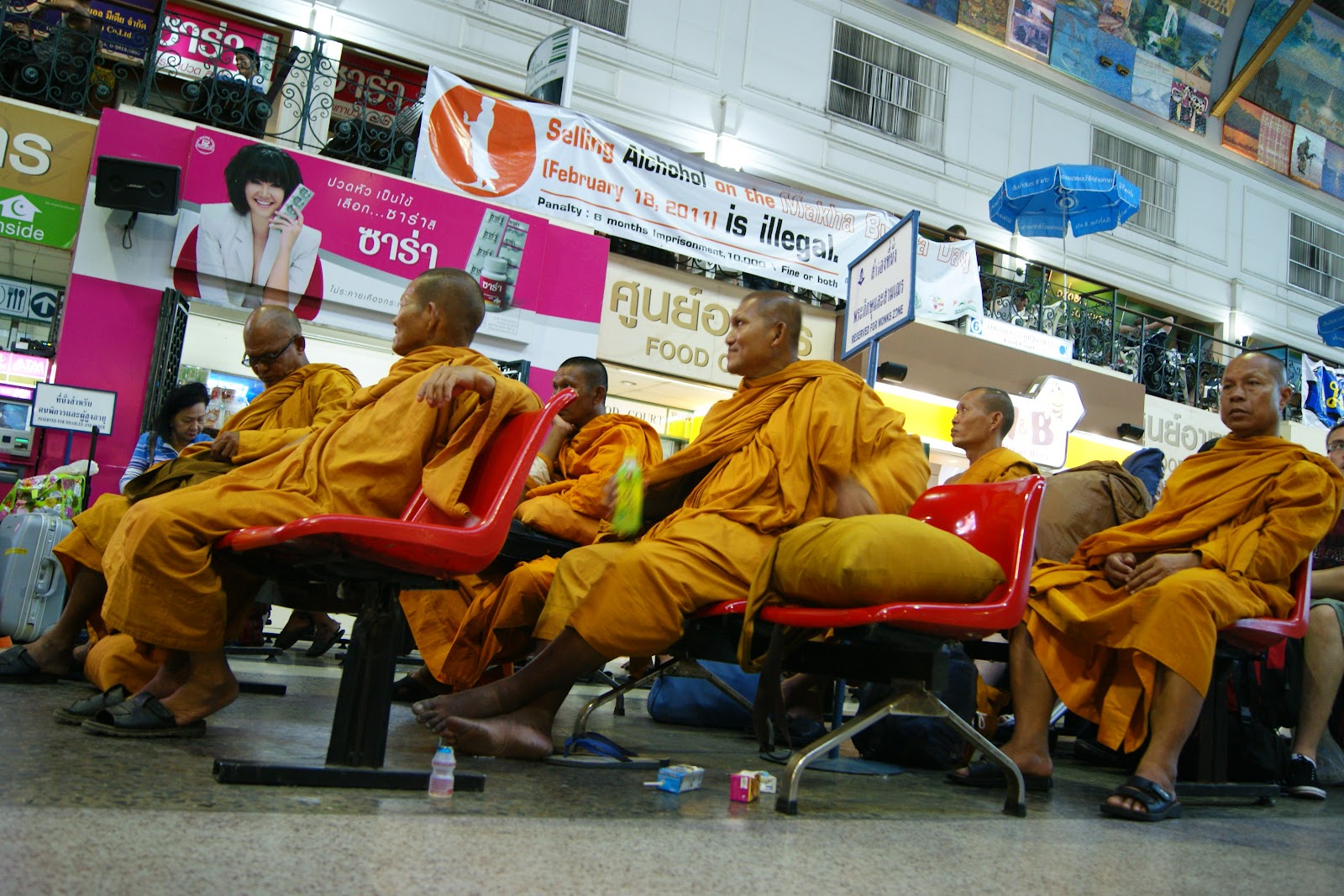
About the etiquette with monks, I have learned that a woman should never get close to them, avoid any physical contact. The lady that I observed sitting next to them at Bangkok train station was looked at as a weirdo by the other people around. Often, not knowing what the etiquette is, foreigners end up making the most clumsy things..! And if gaffes are not fun, I don't know what fun is :)
*** *** ***

Bangkok train station
Seats reserved for monks
Beware, ladies!
"Quanti anni hai?' é una delle prime tre domande che un tailandese vi farà. Non lo fanno per mancanza di buone maniere come un occidentale potrebbe pensare, specie se la domanda é rivolta a una donna. Lo chiedono perché la risposta é per loro importantissima per capire qual é la forma corretta con cui vi si dovranno rivolgere. Per loro io potrei essere una pii (sorella maggiore) o una nong (sorella minore). E' una questione di rispetto. E il rispetto qui va mostrato.
Oggi il maestro di tailandese spiegava i nomi delle dita della mano ai bimbi. Come nella nostra lingua, la parola tailandese per dire indice viene dal verbo indicare. Non appena la parola é uscita dalla bocca del maestro, risatine soffocate hanno percorso la stanza come se fosse stata detta qualche parolaccia! A quanto pare, in queste terre é estremamente maleducato indicare/puntare qualcosa/qualcuno con l'indice. 
Per quel che riguarda il galateo coi monaci: una donna non si dovrebbe mai avvicinare a loro e ogni contatto fisico andrebbe evitato. La turista che alla stazione di Bangkok si é seduta accanto a loro é stata ricambiata con un'occhiata della serie 'ma cosa credi di fare?'. Non sapendo qual é il comportamento giusto da tenere, i turisti finiscono spesso per fare un sacco di gaffe..! E se le gaffe non sono divertenti non so cosa sia il divertimento :)

Monday, 30 May 2011

Night on Thai train

Who would have thought that Thai trains were so good! In South America it was a pity that the train was never an option for serious travelling, although the bus service was excellent. Here instead it has been a pleasant surprise. As I was heading to Chang Mai, in the north west of the country, I got a night train of about 13 hours from BKK. I must say my mind immediately drew a parallelism with Italian trains and service, and the result of the comparison is, shamefully, Thailand-Italy 1-0. Thai trains are comfortable, spatious, clean, nowhere stinky, and the service is impeccable. From the kitchen, waiters come and go asking you if you would like anything for dinner or breakfast and would cook for you and serve it to you. Others go around offering fresh orange juice, snacks and fruit. All most useful details are there or smartly hidden for keeping more space free. I just travelled in a normal second class and there were also matrasses on bed, good pillow, airco, silk courtains, duvet, towel...I must also say that the train was made in Japan (probably the ones they used in the XIX century and then donated to Thailand after the first innovation!), but I must also remind you that Thailand is still in many ways a developing country...Well done then.
*** *** ***

Chi avrebbe mai pensato che i treni tailandesi fossero così buoni (non da magnà)! Quando eravamo in Sudamerica, tristemente il treno non era mai una vera opzione di viaggio, anche se il loro servizio bus era eccellente. Qui, invece, il treno é stata una piacevole scoperta. Diretta a Chang Mai, nel nord ovest del paese, ho preso un treno notte (13 ore circa) da BKK. Devo dire che la mia mente ha subito fatto un parallelismo con treni e servizio italiani e il risultato del confronto aimé e di 1-0 per la Tailandia. I treni tailandesi sono comodi, spaziosi, puliti, da nessuna parte maleodoranti, e il servizio impeccabile. I/le camerieri/e vengono dalla cucina a chiederti cosa vuoi per cena o colazione, lo cucinano e te lo portano. Altri girano per le carrozze offrendo spremute d'arancia fresche, snack o frutta. Tutti i più utili dettagli sono lì o intelligentemente nascosti per risparmiare spazio. Ho viaggiato in una normale seconda classe e c'erano anche materassi, un buon cuscino, aria condizionata, tende di seta, coperta, tovaglia...Altro che trenitalia! Per correttezza devo dire anche che il treno era un made in Japan (probabilmente tra quelli usati tipo nel XIX sec. e poi donati alla Tailandia alla prima innovazione!), ma é giusto anche ricordare che la Tailandia é un paese per tanti aspetti ancora in via di sviluppo...e bravi!

Saturday, 28 May 2011

My first WAT

Believer, incenses and flowers
at the feet of the Buddha
at Wat Indrawiharn
It was a special day today! Not a holiday, but somehow a special day that involved Buddha, family reunion and yellow tuk tuk. No matter how many times I have asked why and how, I didn't get what it was. What was way too clear is that yellow tuk tuk where going to take people all around for a fixed price of 10 THB, about 25 cents. What better solution than speeding through the city with a cheap, colourful and local tuk tuk? Better than a standard taxi, better than a bus for the tuk tuk driver is also a sort of guide, and definitely better than walking since Bangkok is such a huge place! And this is how I've been to lots of Wat today.

The Wat is a temple or monastery temple, typical of Thailand but also Cambodia and Laos. They seem to have many roles, but the ones I have seen so far are all of religious use. Temples are an oasis of tranquillity and peace for the senses in a chaotic, noisy and crowded place such as Bangkok. The contrast couldn't be clearer: the noise of the city vs the calmness of the temples, the smog and dust vs the sweet aroma of incenses and flowers, the dirt of the streets vs the spotless neatness of the temples, the insistence of sellers and tuk tuk drivers vs the few words of the monks, the casual heap of colours around vs the studied harmony of the temples' colours between golden buddha's, precious stones and marbles, the hot in the city vs the freshness of the temple, and finally the hectic pace of the traffic vs the simple grace of those who pray. And I can't help wondering whether it is thanks to the Buddha that here, despite everything, people are so favourably willing...
*** *** ***

Ghirlande/Flowers' garlands
at Wat Benchamabophit
Oggi era un giorno speciale! Non di vacanza, ma un giorno speciale che in qualche modo aveva a che fare con Budda, riunioni familiari e tuk tuk gialli. Nonostante tutte le volte che abbia chiesto come e perché non c'é stato modo di capire di cosa si  trattasse. Quello che era chiaro chiarissimo é che i tuk tuk gialli avrebbero portato la gente in giro per un prezzo fisso di 10 THB, circa 25 centesimi. E quale miglior modo di sfrecciare per la città se non con un tuk tuk economico, colorato e locale? Meglio del tipico taxi, meglio di un bus dato che l'autista di tuk tuk é anche una sorta di guida, e sicuramente meglio che camminare dato che Bangkok é enorme! E questo é come oggi sono stata a tanti Wat. 

Il Wat é un templio o complesso di templi, tipico della Tailandia ma anche del Laos e della Cambogia. A quanto pare hanno funzioni diverse, ma quelli visti fin ora sono tutti di uso religioso. I templi sono una vera oasi di tranquillità e di pace per i sensi in un posto così caotico, rumoroso ed affollato come Bangkok. Il contrasto non potrebbe che essere più evidente: il rumore della città contro la calma dei templi, lo smog e la polvere contro la dolce fragranza di incensi e ghirlande di fiori, lo sporco delle strade contro l'immacolata pulizia dei templi, l'insistenza di venditori e autisti di tuk tuk contro le poche essenziali parole dei monaci, il casuale ammucchio di colori contro la studiata armonia dei colori del tempio tra Budda d'oro, marmi e pietre preziose, il caldo umido della città contro la freschezza all'interno di un tempio e, infine, il ritmo febbrile del traffico contro la compostezza di chi prega. E non posso che chiedermi, tra me e me, se non sia grazie al Buddha che qui, nonostante tutto, la gente sia così ben disposta d'animo...

Friday, 27 May 2011

Bangkok, first impressions

Driving from the airport to the centre.
Pineapples, talisman, the driver calling
I survive to a flight of 12 hours plus an endless stop over in India and arrive in Thailand at 8 am, but my body clearly thinks it's definitely time to go to bed instead. Whatever, I'm in Bangkok, I saw rice fields from the plane!! I pick up my backpack and walk towards the exit. As soon as I'm out of the airport I get literally overwhelmed by the first breath of tropical air, humid, warm, heavy. I get a ticket to the centre and sit on the best spot: I have to take photo's! 

Constructions are everywhere, highways, buildings, in the outskirts of the capital it is all a mix. Glass buildings, law simple roofs all attached together, pile dwellings, trash in the water, a Buddhist temple, a mosque, a van carrying pineapples, the talisman over the driver's head, bridges, turning highway, more buildings, more houses, more trash. Click, click, click! Someone's sleeping naked under a bridge. No click, no photo this time. Little temples at the entrance of neighbourhoods or houses. We enter the city centre. Ombrellas against the sun, a monk in saffron colour, children crossing the streets without waiting for any green light. Taxi, tuk tuk and scooters everywhere. Oh look, scooters wear helmets here! Click click click!

I get off, start to walk towards the Democracy monument. I have a map, a backback and a foreign look...irresistible for locals. 'Miss, tuk tuk?', no-thanks-face, 'Miss, where are you from?' 'Italia' 'Oh, Italia good, Baggio Buddha!'...ahahah, how cool! Wait, that's a drop, oops, and a thunder! Not even time to realise and it's already raining on my head. A thunderstorm. It will last for hours, while I seek refuge under the umbrella of a smiling old woman sellings beverages. 'I might take a tuk tuk after all'. And there he comes, this man looking more like a Vietnamese, smiling and teethless, and his green tuk tuk, ready to drive me through the rain. I'm the happiest girl when I enter my room and abandon myself on the bed. 

Tomorrow, as a good tourist would do, I'll go to the temples along the Chao Phraya river...

Sopravvivo a un volo di 12 ore, piú un lungo scalo in India e arrivo in Tailandia alle 8 del mattino, ma il corpo pensa invece che sia decisamente ora d'andare a letto! Ma insomma, chi se ne importa, sono a Bangkok, ho visto un sacco di risaie dall'aereo! Prendo il mio zaino e cammino verso l'uscita. Non appena esco dall'aereoporto vengo sopraffatta dalla brima boccata d'aria tropicale, umida, calda, pesante! Prendo un biglietto per il centro e mi siedo sul posto migliore: ho foto da scattare!

Ci sono costruzioni ovunque, autostrade, palazzi, nella periferia della capitale é tutto un mix. Palazzi di vetro, tetti semplici e bassi tutti attaccati, palafitte, spazzatura in acqua, un tempio buddista, una moschea, un furgoncino carico di ananas, il talismano sulla testa dell'autista, ponti, autostrada in curva, ancora palazzi, ancora più case e spazzatura. Click, zic, zac! Qualcuno dorme seminudo sotto un ponte. Stavolta niente scatto, niente foto. Piccoli tempietti all'entrata di un quartiere o diuna casa. E siamo nel centro della città. Ombrelli contro il sole, un monaco in color zafferano, bambini che attraversano senza aspettare il verde. Taxi, tuk tuk e motorino dappertutto. Guarda un pó, si mettono il casco qui! Zic zac scatto!

Scendo dal bus, comincio a camminare verso il monumento alla democrazia. Ho una mappa, uno zaino in spalla e un look straniero...sono praticamente irresistibile per i locali. 'Signorina, tuk tuk?' faccia della serie no-grazie, 'Signorina, da dove viene?' 'Italia' 'Oh, Italia, l'Italia mi piace, Baggio Budda!'...che risata, troppo forte! Aspetta, ma quella é una goccia, e quello un tuono! Non ho neanche il tempo di far mente locale che giá mi piove in testa. Un temporale. Durerà per ore, mentre cerco rifugio sotto l'ombrellone di una nonnetta sorridente che vende bibite. 'Magari lo prendo un tuk tuk'. Ed eccolo lí, un ometto che sembra più un vietnamita, sorridente, sdentato e col suo verde tuk tuk pronto a guidarmi sotto la pioggia. Non appena entro in stanza e mi abbandono sul letto, sono la ragazza più felice che c'é.

Da brava turista, domani andrò ai templi lungo il fiume Chao Phraya...non ve lo perdete...

Thursday, 12 May 2011

Barcelona en 24 horas

That favourite square of mine
Arriving at El Prat aeropuerto palm trees and a fresh sea breeze welcome us in Catalunya! The bus leads us all directly to the centre on Plaza Catalunya where all the tourists suddenly appear to be. I hear Italian all around, quite a lot of American-English and I realize that Barcelona is a tourist destination that suits all ages. School kids, teenagers, young ones seeking fiestas, older ones enjoying the freedom of their retirement, entire families. There's something for everyone. At the boquería I have the slight sensation to be ripped off with a cocco-ananas juice for 2,50...although my wondering disappears at its fresh and delicious taste. At Port Vell dozens of northern white skins together with sun-dependent southamericans plus me enjoy the sun on this summerish spring day. Quick metro to Parc Güell and yet again on another tourist spot, but rightly so. How could you not like the genius of Gaudí?!  I have the time to discuss that when I'll be making my house, I'll have a patio just like that, with different mashed tiles put together in a new colourful collage...and then on to the Sagrada Familia, where works continue and the masterpiece looks different every time. We're so lucky we don't have to queue! Now its interiors are basically completed, the temple is welcoming and it looks beautiful! Later on, a walk around the Barri Gotic leaves us mouth open!  Going through old Roman roads and walls, Medieval buildings and streets, we walk all the way down to Santa Maria del Mar (one of my favourite squares in the city by the way) and we are just on time to catch the last rays of sun at the beach, Barceloneta. It is time for eating or at least tapear (thought only specific places in Andalucía really know what tapear is all about!). We end up doing the latter and talking to a couple of Argentinians improvising tango around my favourite square. The night is still young and streets are crowded 24/7. Back to El Prat airport, a group of Spanish families clap the welcome to their highschool children coming back from London! Hugs and kisses for everyone by everyone and see you tomorrow. Even they are happy to be (back) in Spain. Ah, España, what a vibe! or as that package of cigarettes alarms :'Spain provokes a fatal addiction to the good life'!

More photos of BCN here

Tuesday, 10 May 2011

Plitvice Lakes National Park

Crystalline water at the lower lakes
This is another Croatia. Away from the more expensive coast there is a green green land. Made of mountains and lakes, and serving meat dishes instead. The National Park of Plitvice Lakes stands right in the middle of it, a lovely oasis where lakes and waterfalls follow one another. It's the biggest National Park of Croatia and a UNESCO World Heritage site since 1979. Enjoy some photos here!

Saturday, 7 May 2011

Za-nzi-dar

Sunset in Zadar
Feeling like home! ...at least it seems so: Zadar is caressed by the cold bora as it happens in Trieste, its centre has the smoothest roman roads like in Venice, and a blue blue sea laps its shores, like home. And if it wasn't that locals are able to speak and understand so much Italian, one might think to be on the other side of the Adriatic coast. The girl we meet the first night at the restaurant Bruschetta (yes, like bruschetta...) tells us she studies Italian at the University in Zadar. She likes it and while she speaks Italian with us, she calls her city Zara. She says fish is delicious here, particularly fresh in this very restaurant. She is 22, wears big rings earrings and leopardskin shoes with a 12cm heal. I'm wearing jeans and converse and have fading make-up...she concludes I can't be older than 21. Lol. I guess local standards are high here! Before leaving, she briefs us on the disco panorama of Zadar. Lively, vibrant. We're in the Balkans after all!

Fish is indeed fresh and delicious here. I mean, that doesn't need explanations, it's the blue fin Mediterranean product we are talking about! According to local customs it goes more or less like this: Joe orderes fish, the waiter goes back to the kitchen and, before cooking anything, shows the freshly fished fish to Joe; Joe sees that it's indeed fresh and thanks the waiter; the fish is grilled/cooked/stewed/whatever and ready; the waiter comes back, showing once again the chef's results to Joe and starts to clean it from the fishbones for him; the waiter ends its job and Joe can finally eat its fish. Ah, what a service!

With our full tummies we stroll through the old centre, separated by the mainland by a bridge, nowadays, or by a moat, back in the years. The sun shines, the atmosphere is welcoming and the sea organ is absolutely captivating! Architect Nikola Bašić had the great idea to create by the sea in Zadar an experimental musical instrument which plays by sea waves...check out this youtube video! and enjoy this photo album!

Translate