Thursday, 14 February 2013

red for new year

So happy and proud of her red dress, she was all set to celebrate Chinese New Year!
☺☺☺
Così allegra e fiera del suo vestitino rosso, era tutta pronta per festeggiare il nuovo anno cinese!

Tuesday, 12 February 2013

tarantulas

Hehe, noto dalle statistiche del blog che il pubblico attende notizie, soprattutto in Olanda, ferventi lettori. Niente di chissacché. Ieri ero nel mio vestito migliore, mentalmente pronta ad onorare una cena diversa, tra l'osceno e lo speciale, comunque una delicatezza locale. Tarantole. Gli amici non ti fanno fare cose pazze da sola, e cosí Chenda ha avuto l'idea di prendere una manciata di cavallette e due tarantole da una venditrice ambulante senza pensarci due volte, per poi sederci in un posticino vietnamita lí vicino. Leggo adesso che queste creature sono conosciute per essere commestibili da giá un centinaio d'anni, quindi niente di preoccupante. Certo, essendo abituati a mangiare pollo dissossato, frutta senza buccia e roba trattata e conservata, va effeto vedersi un pezzo di giungla nuda e cruda nel proprio piatto. Non c'é nient'altro da fare che mettere le apparenze da parte e cominciare dal prenderlo in mano, staccargli una zampa, assaggiare la zampa, notare che tanto male non é, anzi é tutta croccante, e continuare fin quando é finito. Scommetto che la domanda é: che sapore ha? Dato che é fritto e caramellizzato, sa di dolce! E se vi chiedete perché mai mangiarseli, parliamone! Ora che ho finito le mie esotiche sperimentazioni, che il mio stomaco é forte come non mai e che niente mi fa impressione, cioccolato please!!! 

♫ ♬ ♪ ♩ ♭ ♪♬♪♩♭♪
From the blog's statistics I can clearly see that my loyal readers are fervently waiting for news. So, here comes the story. Yesterday I was dressed in my nicest cloths and mentally prepared to honor a different dinner, perhaps obscene yet special, involving a local delicacy. Tarantulas. Friends don't let you do crazy things alone, and it was Chenda who had the idea to get a bunch of grasshoppers and a couple of spiders from a street vendor without much ado. Then we sat at a Vietnamese place nearby, ready to go. I read now that these creatures are known to be edible for more than a hundred years. Nothing to worry about then! Certainly, when you are used to boneless chicken, peeled fruit and processed everything, it feels kind of challenging to have a raw piece of jungle right in your plate. Yet, as usual, one ought to go beyond appearances, and start by taking it in the hands, then pull off a leg, taste the leg, sense how nicely crispy it is, and continue until is finished... I guess the question is: what does it taste like? Well, tarantulas are fried in oil and then caramelized in sugar, so the taste is rather sweet! And if you are wondering why on earth would one eat them, we can talk about it next time. Now that I am at the end of my gastronomic experiments, that my stomach is stronger than ever and that I fear nothing in my plate...gimme chocolate fondue please!!!

Saturday, 9 February 2013

what's in a skyline?

Phnom Penh seen from my rooftop
Skylines are the fingerprint of a city, as no two skylines are alike, wikipedia says. For what I've seen across Southeast Asia, Singapore's skyline was perfectly studied, with everything in its place. In fact, a skyline says a lot about its city. Bangkok's skyline was alredy far from the organized Singaporean fashion. Banks, hotels and temples all rival to get attention in Bangkok's jumbled cityscape. Phnom Penh, is something else. I remember the feeling when I set foot on Phnom Penh soil for the first time in September. Coming from chaotic Bangkok, Phnom Penh felt peaceful and pleasant. The absence of evident skyscrapers felt almost reassuring. The low-rise city felt human sized. 
Phnom Penh's skyline is still modest for the time being. The two tallest buildings in town, Canadia Bank and Vattanac Capital (the latter still in costruction at the time of writing) have 32 and 39 floors respectively, which is nothing if compared to the trend in the region (the Petronas Towers in Kuala Lumpur have each 88 floors, Bayoke Tower II hotel in Bangkok has 85 floors, the OUB Centre in Singapore had 63 floors in 1986 already, and the tallest tower in the Philippines PBCom has 52 floors). Construction plans are fast and furious and there are rumors that in the future the tallest buildings in Southeast Asia might be precisely in Phnom Penh. My Ratanakiri folks must be speechless about this madness. But their opinion does not count when it's about polishing the image of poor Cambodia with the deceptive glamour of progress. Sihanouk's Master Plan has clearly being forgotten. According to his plan, no building in Phnom Penh could be higher than the Royal Palace.
▼▼▼ ▼▼▼ ▼▼▼


Lo skyline [letteralmente la linea che la città traccia nel cielo] è l'impronta di una città dato che, come dice wikipedia, due skyline uguali non ci sono. Da quanto ho visto nel sud-est asiatico, lo skyline di Singapore era perfettamente studiato, con ogni cosa al suo posto. Per chi lo sa leggere, lo skyline di una città rivela infatti tante cose su quella città. Quello di Bangkok era già lontano dall'organizzazione stile Singapore. Banche, hotel e templi fanno a gara a chi riesce ad ottenere più attenzione nel miscuglio bangkokkiano. Phnom Penh è tutta un'altra storia. Mi ricordo la sensazione che ho avuto la prima volta che ho messo piede a Phnom Penh a settembre. Venendo da una caotica Bangkok, Phnom Penh sapeva di un posto calmo e gradevole. L'assenza di grattacieli aveva un chè di rassicurante. Case ed edifici bassi tutt'intorno me la facevano sentire a misura d'uomo. 
Lo skyline di Phnom Penh è per adesso ancora modesto. I due edifici più alti, il Canadia Bank e il Vattanac Capital (questo qui ancora in costruzione) hanno rispettivamente 32 e 39 piani. Una sciocchezza, considerato il trend nella regione (le Torri Petronas a Kuala Lumpur ne hanno 88 ciascuna, l'hotel Bayoke Tower II a Bangkok ne ha 85, l'Oub Centre a Singapore ne aveva 63 nel 1986..., e la torre più alta delle Filippine PBCom ha 52 piani). I piani edilizi proseguono veloci e furiosi, e si mormora che nel futuro gli edifici più alti del sudest asiatico saranno proprio qui a Phnom Penh. Già mi vedo i miei compari di Ratanakiri a bocca aperta dinanzi a questa mancanza di buon senso. Ma loro a quanto pare non contano niente quando si tratta di patinare l'immagine della povera Cambogia con l'illusorio luccichio del progresso. Il piano regolatore in vigore sotto Sihanouk è stato chiaramente dimenticato. Secondo il suo piano, a Phnom Penh non potevano esserci costruzioni più alte del palazzo reale.

Thursday, 7 February 2013

leggere

Reading habits are almost inexistent in Cambodia. It is a pity and a shame, without wanting to sound paternalistic. There is no 100% alphabetization in the country and under the Khmer Rouge one could only dream of reading a book. Writers, together with other intellectuals and artists, were simply swept away. La crème de la crème of the nation, lost forever. Today readers are shy, or lazy. Fortunately there  are many initiatives and programmes committed to improve the situation, like the mobile libraries, which have children's reading habits dear to their heart. It is when I see these scenes (a tuk-tuk driver with his fairy-tales book or a young boy absorbed by a good read) that I am touched and left with the hope that one day the Khmer may become thirsty for reading. :)
☻☻☻ ☻☻☻


Leggere non è un'abitudine qui in Cambogia. E' un peccato, senza voler suonare paternalista. Nel Paese non c'è un tasso di alfabetizzazione del 100% e sotto i Khmer Rossi uno non se lo sognava neanche di leggere un libro. Gli scrittori, come tanti troppi intellettuali, venivano perfino spazzati via. La crème de la crème della nazione, persa per sempre. Oggi i lettori sono timidi e pigri. Ma fortunatamente ci sono tante iniziative e programmi che si impegnano perché la situazione migliori, come per esempio le librerie mobili, che hanno a cuore di incoraggiare l'abitudine dei bambini alla lettura. Ed è per questo che quando vedo queste scene (un autista di tuk-tuk col suo libro di favole cambogiane o un giovanotto assorto nella lettura) mi commuovo e mi riempio della speranza che un giorno questo popolo sarà assetato di lettura. :)

Wednesday, 6 February 2013

un sacco pieno di cenere

King Norodom Sihamoni over the body of his Father
(C) Documentation Centre of Cambodia
As I live in a busy area in Phnom Penh, I was surprised when on Friday morning, 'crying day', I woke up in the middle of the silence. Phnom Penh gives a SCARY feeling when is silent and no tuk-tuk or motorbike can be seen. The wider zone around the Royal Palace, from the Independence monument until Wat Phnom (!), had been closed off to the traffick for the procession of the King Father's body around town. With their black and white outfit, people were already walking in all directions at 7am to choose the best spot. They waited for hours for their King Father to pass by. His body would leave the Royal Palace and enter the Royal cremation ground. Monday was the actual day of the cremation. But that day Sihanouk was no longer for his peoples. For the most crucial part of that day the Royal cremation ground was not accessible to common people while VIP government officials and foreign delegations had the priviledge to witness the cremation of the King Father. All others were left with the view of the smoke of the cremated body, with the fireworks, and with the (most boring) TV coverage (ever seen in my life). The Khmer people, elderly, children and monks, were rightly disappointed. "Nation, Religion, King" is the country's motto. Three words I find on the top of every official document. Three words that most likely sum up Cambodian identity. That night, while Sihanouk body was becoming ashes, the nation was kept far from his beloved King Father. The day after, when a part of his ashes were brought to the shores of the Tonle Sap river to be dispersed, the spectacle was not for all. Nevertheless, this has not stopped the Khmer from gathering and praying together in front of a screen, lightening candles and incenses. Finally it was not the fuss going on near the royal palace that made all the atmosphere of this particular event, but it was the everyday people kneeling at any corner of any street with their little candle lit up for their King.  

○○○ ○ ○○○ ○ ○○○ ○ ○○○
Smoke coming from the Royal Cremation Ground
(C) Documentation Centre of Cambodia
Abitando in una zona molto trafficata, mi sono sorpresa quando venerdì mattina, 'il giorno del pianto', mi sono svegliata nel bel mezzo del silenzio. Phnom Penh fa paura quando è silenziosa e non si vedono nè tuk-tuk nè motorini nei paraggi. Tutta la zona intorno al palazzo reale, dal monumento all'indipendenza fino a Wat Phnom (!), è stata chiusa al traffico per la processione del corpo del re padre per la città. La gente, vestita tipicamente in bianco e nero, era impegnata a scegliersi il posto migliore per vederla già dalle 7 del mattino. Hanno aspettato per ore che il loro re padre passasse. Il corpo del re padre ha poi lasciato il palazzo reale per entrare nel padiglione/mausoleo fresco fresco di costruzione adibito alla cremazione reale e a tutte le sue cerimonie. Lunedì era il giorno della cremazione. Ma in realtà, quel giorno Sihanouk non era più per il suo popolo. Per tutta la parte più importante di quel giorno, il padiglione della cremazione non era accessibile ai comuni mortali, ma importanti ufficiali di governo e delegazioni estere sono stati tra i pochi ad avere il privilegio e l'esclusività di testimoniare alla cremazione del re padre. Tutti gli altri sono stati lasciati con la vista del fumo del corpo cremato spargersi per un cielo blu notte, con il rombo dei fuochi d'artificio, e con la (più noiosa) copertura televisiva (mai vista in vita mia). Il popolo cambogiano, vecchi, bambini e monaci, erano giustamente delusi. "Nazione, Religione, Re" è il motto del paese. Sono tre parole che vedo sempre stampate su ogni documento ufficiale. Forse le tre parole che meglio riassumono l'identità cambogiana. Quella notte, mentre il corpo di Sihanouk diventava cenere, la nazione è stata tenuta lontano dal suo amatissimo re padre. Il giorno dopo, quando parte delle sue ceneri sono state portate sul fiume Tonle Sap per essere disperse, lo spettacolo non era per tutti. Ciononostante, questo non ha fermato il popolo khmer dal riunirsi e congiungersi in preghiera davanti a un grande schermo, accendendo candele e incensi per il loro re. In fondo non è stata la formale agitazione vicino al palazzo reale a creare l'atmosfera di questo particolare evento, ma è stata proprio la gente di ogni giorno inginocchiata a un qualsiasi angolo di strada con la sua candelina accesa.

Sunday, 3 February 2013

Cardamom Mountains

Just before sunrise on Phnom Trangol
This time I take you to the southern Cardamom mountains, where the forest is protected and Cambodia's landscape retains the beauty of its rawness and wildness. If over a year time about two millions tourists visit the temples of Angkor, only around a thousand people venture to this place. The record of the Khmer Rouge fighting on these peaks until the early 1990s, today leaves space to the warm greetings of the children in the villages, and all around the peace of nature. Wasting no more words, enjoy some photos!
♣♣♣ ♣♣♣ ♣♣♣
Questa volta vi porto per i monti del Cardamomo, dove la foresta è protetta e il paesaggio cambogiano ritiene la sua selvaggia e cruda bellezza. Se durante l'anno circa due milioni di turisti visitano i templi di Angkor, solo un migliaio si avventura per queste zone. Il ricordo dei Khmer Rouge che fino agli inizi degli anni '90 guerrigliavano sulle cime di questi monti, oggi lascia spazio ai saluti accoglienti dei bambini dei villaggi, e alla pace della natura tutto intorno. Non spreco altre parole e vi lascio alle foto qui!

Tuesday, 29 January 2013

forest


Cambodians remember when in the past years the road through Ratanakiri province was a road through the thick forest. Today, deforestation, logging concessions and land grabbing have changed the landscape of the province. This little house now stands alone with a few bushes around and the forest way behind...
“What we are doing to the forests of the world is but a mirror reflection of what we are doing to ourselves and to one another” - Gandhi 
♣♣♣ ♣♣♣ ♣♣♣
A rubber plantation
I cambogiani si ricordano che negli anni passati la strada che attraversa la provincia di Ratanakiri era una strada che attraversava la foresta. Oggi, la deforestazione, le concessioni forestali e le appropriazioni di terreni hanno cambiato il volto di Ratanakiri. Questa casetta si erige sola in mezzo a qualche cespuglio, mentre la foresta arretra sempre più...
"Quello che stiamo facendo alle foreste del mondo non è che un riflesso di quello che stiamo facendo a noi stessi, gli uni agli atri" - Gandhi

Monday, 28 January 2013

tra verde e blu

Ratanakiri, Yak Loum lake. Set in a 4.000 year old volcanic crater, the lake it perfectly round, extremely deep, the water clear. A pleasure for divers!
♣♣♣   ♣   ♣♣♣
Ratanakiri, lago di Yak Loum. Situato in un cratere vulcanico di ben 4000anni fa, è perfettamente rotondo, estremamente profondo, l'acqua pulita. Una goduria tutta da tuffarcisi!

Sunday, 27 January 2013

bellezza indigena

Back to Ratanakiri, home to the majority of Cambodia's indigenous peoples. When not busy working, this girl becomes a dancer of traditional group dances.
☻♥☻      ☻♥☻
Di nuovo a Ratanakiri, dove vive la maggiorparte delle popolazioni indigene della Cambogia. Questa ragazza, quando non è impegnata a lavorare, diventa un danzatrice di danze di grouppo tradizionali. 

Saturday, 26 January 2013

fishing at sunset

Ratanakiri province is among the most remote provinces of the country, where ricefields make space to forests. I have been there already three times, and each time the freshness of the air and the mountainous landscape are a bliss. Would this fisherman agree?
→← →← →←
Ratanakiri è una delle province più remote della Cambogia, dove la risaia fa spazio alla foresta. Ci sono già stata tre volte, e ogni volta l'aria fresca e il panorama di montagna sono una meraviglia. Chissà se questo pescatore è d'accordo...

Friday, 25 January 2013

Snacking the night away

My working hours are from 8am to 5pm. The day before a workshop we have organized we worked until 22:00pm. Me, my pregnant colleague Chenda and Vuy the guard kindly feeding us with bbq meat and baby duck eggs from the street... Memorable day, excellent workshop.

♣♠♥♦  ♣♠♥♦
Lavoro normalmente dalle 8 del mattino alle 5 del pomeriggio. Il giorno prima di un workshop che abbiamo organizzato siamo rimaste in ufficio fino alle 10 di notte. Eccoci qua, io, la mia collega incinta, Chenda, e la guardia, Vuy, che gentilmente ci ha nutrito con carne alla griglia e uova di baby papera prese in strada stile locale...Un giorno memorabile, un workshop eccellente.

Monday, 21 January 2013

Leggermente pazzi

Non c'era niente, e adesso il sito per la cremazione del Re è quasi pronto, con le ultime rifiniture da perfezionare. Il tutto, dal chiacchierato costo di 1milione di dollari (o erano 5?!), vedrà un altrettanto milione di gente, come minimo, presenziare appassionatamente alla settimana di lutto dal 1 al 7 febbraio. Per dirla tutta, a mia grande sorpresa ho appreso che il sito viene montato ogni volta che muore un re, per poi essere rismontato a cerimonia conclusa...la follia!
☻☻☻ - ☻☻☻

It was all empty, and now the site for the King's cremation is almost ready, the last finishings being refined to perfection. The whole site, which costed 1mln US dollars (or was it 5mln?!) will host a mln people too, at least, during the mourning week between 1-7 February. I was quite shocked to learn that the cremation site is assembled every time a a king dies but once the ceremony is over it is dismantled, leaving space to sand and grass...!

Tuesday, 15 January 2013

al parco...

Questa é una storia di prostituzione, ma non del tipo a cui siamo abituati. Secondo la storia, c'è un parco qui a Phnom Penh, giusto dietro Wat Phnom, dove vanno bei giovinotti al calare della notte. Non cercano donzelle, piuttosto le aspettano. Più tardi, con la complicità del buio, ricche e vecchiotte signore si recano al parco anche loro e scelgono il giovanotto che più le attrae. Dopo un pò, l'improbabile coppia si ritira dietro coprenti vetri di una macchina piena d'aria condizionata e insieme scompaiono per luoghi che a noi non é dato conoscere...
☻☻☻ ☻☻☻

This is a story of prostitution, but not the kind we are used to hear. As the story goes, there is a park in Phnom Penh on the back of Wat Phnom, where young handsome men would go at night. They don't look for ladies, they rather wait for them. Later on, in the darkness of the night, older rich women would also go to the park and pick the handsome man that they fancy the most. Then, they would disappear together inside an aircon car to places that remain to us unknown...

Monday, 14 January 2013

Glasses

Professionals at work in Phnom Penh
E dopo le scarpe, tocca agli occhiali. Farsi fare un paio d'occhiali qui (montatura+lenti) è tutto un business che batte ogni servizio europeo. Non solo i costi sono quelli che sono (bassissimi), ma la velocità del servizio fa quasi mettere in dubbio la qualità del prodotto finale. Nella fattispecie, in Belgio le mie lenti graduate e anti-riflettenti costano la bellezza di circa settanta euro per lente. Ad Hanoi, in Vietnam, scendiamo a circa sette euro per lente. In Cambogia serve poco più che in Vietnam. Per le montature è facile trovare versioni taroccate, che non per forza sono di bassa qualità, e che ripeto non costano niente. La convenienza c'è anche con le versioni originali. Ma in realtà non è solo una questione di prezzi. Perché bisogna aspettare più o meno una settimana per farsi fare un paio di occhiali a casa? E perché sia in Cambogia che in Vietnam lo stesso prodotto è pronto nel giro di un paio d'ore? Obbiettivamente parlando, quanto tempo serve per fare un paio di occhiali? E perché quando la lente si sganciò dalla montatura in Belgio hanno detto che era impossibile da riparare (o sarebbe servito tanto tanto tempo) mentre ad Hanoi la sua reparabilità non è stata neanche punto di discussione e pochi minuti dopo era di nuovo tutto al suo posto??? Io ve lo dico, venite in Asia coi vaccini fatti e la valigia vuota, il resto lo troverete qui.
☼☼☼ ☼☼☼ ☼☼☼
The 'glasses street' in Hanoi
After shoes, it's time for glasses. To have glasses made here is quite a business that cannot be compared to any European service. It's not only a matter of (very low) cost, but also of the speed of the local service, which almost makes you doubt about the quality of the final product. To be specific, in Belgium my graduated and anti-reflective lenses cost a whopping seventy euro per lens more or less. In Hanoi, they are about seven euro per lens. In Cambodia slightly more. When it comes to frames, it is easy to find many copied versions, but they are not necessarily of bad quality. Even the original frames are still quite convenient. But as I said, it's not just about prices. How come that back home a new pair of glasses can be ready in about a week, while both in Cambodia and Vietnam it would be ready in the next couple of hours? Objectively speaking, how much time is needed to make a new pair of glasses? And why oh why, when the lens disconnected from the frame, in Belgium they said that it was impossible to repair or that would take a long long time to fix, while in Hanoi they didn't even question its 'fixability' and shortly after the glasses where fine as before breaking??? I just tell you, come to Asia with the vaccinations done and an empty suitcase, you'll find the rest here.

Sunday, 13 January 2013

My piede

Questa è la mia pianta del piede destro, uno schizzo su cui il/la calzolaro/a (chiaramente di origini vietnamite) mi farà scarpe su misura! Posso scegliere forma, colore e sbizzarrirmi, e il tutto non costerà più di venti dollari. Dove sono finiti i nostri calzolai? Perchè oggi come oggi riparano solo tacchi e aggiungono buchi alle fibbie??? Abbasso l'industria!!!
♣♣♣ ♣♣♣ ♣♣♣
This is my foot. The shoemaker (clearly of Vietnamese origins) is going to use this to make me tailor made shoes. I can choose shape, colour, fancinesss...and they won't charge me more than 20 dollars. Where are our shoemakers? Why do they only repair heels and add holes into buckles??? Down with the industry!!!

Saturday, 12 January 2013

Cantiere aperto

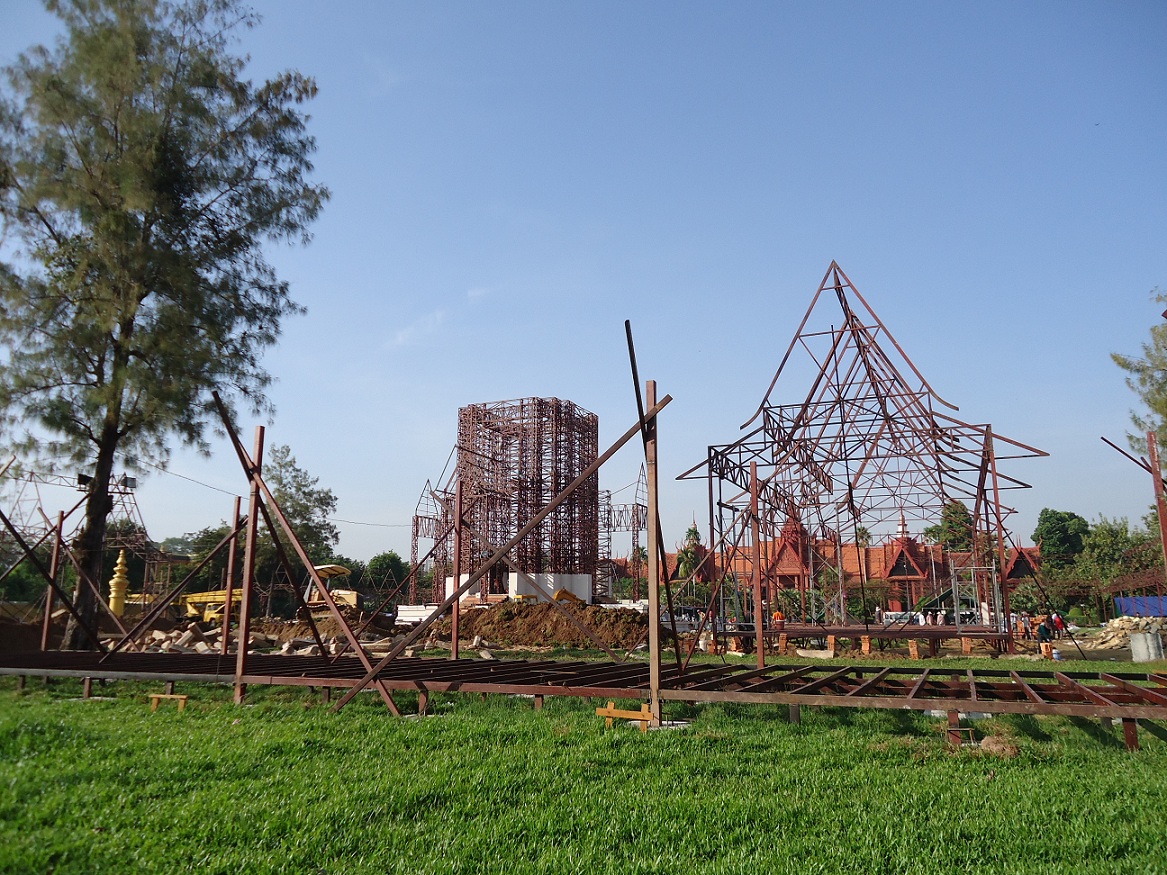
Si prevede che i funerali di Re Sihanouk abbiano luogo per la prima settimana di febbraio. Come da tradizione, il tutto avverrà sul terreno antistante il museo nazionale adibito alla cremazione dei reali. Nel giro di un mese ho visto aprirsi un cantiere di instancabili lavoratori che giorno e notte hanno fatto si che il paviglione della cremazione prendesse vita alla velocità della luce! Moto, motorini, tuk-tuk, bici, macchine e bus che passano di là, si fermano ad ammirare e rimirare che grandi cose i cambogiani sanno fare per il loro amato re-padre. Già il cantiere ha tutta un'aria solenne. Potrò vedere presto come sarà dal vivo per i funerali più memorabili degli ultimi cinquecento anni.

♣♣♣ ♣♣♣ ♣♣♣

The funerals of king father Sihanouk will take place in the first week of February. The ceremony will take place as tradition wants, on the royal cremation ground in front of the national museum. I have been totally amazed in seeing the construction site coming to life at the speed of light! In about one month, I have seen tireless workers being busy day and night. Now whoever passes in front of the site, motorbikes, bikes, tuk-tuks, cars, buses and people, they all stop to admire the great things that Cambodians are able to bring to life for their beloved King Father. The site has already a solemn atmosphere. I will very soon see how the most memorable funeral of the last 500 years will be.

Friday, 11 January 2013

Just under your eyes

The exquisite building on the left is the Indipendence Monument, a nodal point within the urban jungle of the city, everyone knows where it is. South of it, roads become bigger and houses more spacious. Traffic, however, stays just as crazy as everywhere else. But as you might notice the arrow, I want to focus on the (huge) house just behind it. I didn't notice it at first and just like any other tourist I would walk past it being busy looking at the Indipendence monument and probably also thinking of how on earth to cross the round about and get to the other side...The house  is one of the houses of uncle Sen, the man who runs the show in the country and has a crystal ball in place of one eye...Don't let me reveal his name. Thinking of a parallelism back home, I am actually quite disappointed I don't know where Barroso lives.
◘◘◘   ◘◘◘   ◘◘◘
Il particolare edificio a sinistra è il monumento all'indipendenza della Cambogia, un punto nodale che nella giungla urbana di Phnom Penh conoscono tutti. Al sud del monumento le strade diventano più larghe e le case più spaziose. Il traffico invece resta sconclusionato come sempre. In realtà, come suggerito dalla freccia, richiamo la vostra attenzione sulla casa dietro al monumento. Le prime volte non l'avevo notata neanche io, e come tutti i turisti sono passata oltre senza notarla perché troppo impegnata a far foto del monumento e probabilmente anche a pensare a come gestire la rotonda e attraversare la strada...Ebbene, la casa (tre tetti e quattro piani) e una delle dimore dello zio Sen, l'uomo che porta avanti "quest'immenso show" cambogiano e che ha una crystal ball al posto di un occhio...Non fatemi rivelare il suo nome. Ora che ci penso, facendo a un parallelismo dalle nostre parti, sono abbastanza delusa dal fatto di non sapere dove abita Barroso.

Thursday, 10 January 2013

Best time of the year

It feels like the best time of the year in Phnom Penh! Sunny, with steady 28degrees, no rain and scarce humidity. Not too hot, not to cold. The breeze from the rivers tempers the heat of the hottest hours during the day, and at night there is no need for airco. As you can imagine, I am not missing any winter. But in a couple of months I will probably miss these kind of Phnompenhish-days...
###    ###    ###
A Phnom Penh sembra di vivere il miglior periodo dell'anno. C'é sempre il sole, 28 gradi fissi, senza pioggia e con poca umiditá. Non fa né troppo caldo né troppo fresco. La brezza dei fiumi tempera le ore più calde della giornata e di notte non c'é bisogno dell'aria condizionata. Come potrete immaginare, non sento la mancanza di nessun inverno, anzi, tra un paio di mesi mi mancheranno queste giornate phnompenhniane...

Monday, 7 January 2013

Crickets

Cricket entering the abyss
Duck eggs and cricket

That's it. That's the moment I look it in the eyes and put it in my mouth. 'It' is a cricket, a fried cricket, a Cambodian delicacy. Tastes like something familiar, I better not tell you, but it's totally edible! All in all, it only looks worse than it really is. Actually, it's not worse than the ultra stinky maroilles cheese from Lille city!
☻☻ ☻ ☻☻

Ebbene è arrivato il momento di essere audaci, di guardarlo negli occhi e metterselo in bocca. Ma chi, cosa? Il grillo! Fare merenda con grilli fritti e uova di quaglia è quanto dire. Tutte prelibatezze cambogiane. Riconosco in quel grillo un sapore familiare, di stigliole palermitane grigliate al mercato lì per lì. Sensazione stranissima, ma in fondo non è così male, è solo difficile guardalo negli occhi! A dire il vero è anche meglio del famoso formaggio francese maroilles di Lille!

Saturday, 5 January 2013

Happy 2013!

Many wishes from Bobby Chinn's restaurant in Hanoi!

Translate